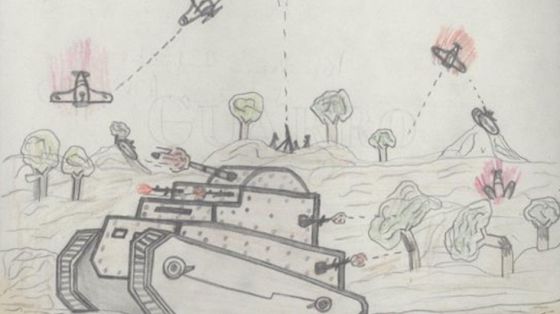
“Querido padre, yo quiero que venga pronto, vivo en la URSS y quiero mucho a España”, escribía Sergio Vargas, un niño de tan solo ocho años que con sus lápices de colores recordaba a su familia en Madrid. Al igual que Sergio, cuando comenzó la Guerra Civil cientos de niños se convirtieron en víctimas y espectadores del conflicto.
Desde el otoño de 1936 al final de Guerra, el gobierno republicano creó varias colonias escolares en la retaguardia, en especialmente en la Comunidad Valenciana, Cataluña y Murcia y organizó un plan de evacuación de los más pequeños procedentes de las zonas más amenazadas, como Madrid o Teruel.
En estas colonias los niños y niñas plasmaron en imágenes lo que sentían. La Sala Aifos, en la facultad de Filosofía y Letras de la Universidad de Alicante, acaba de inaugurar la exposición inédita Llapis, paper i bombes. 1936-1939 (Lápiz, papel y bombas1936-1919). Una muestra integrada por un centenar de dibujos que realizaron esos niños y niñas que fueron evacuados a diversos lugares de Europa durante la Guerra Civil, donde recibieron cuidados y formación en colonias seguras.
Durante su estancia los pequeños inmortalizaron sus desgarradoras experiencias de la guerra en unos dibujos con lápices de colores. Sus autores tenían entre 7 y 14 años, y la mayoría dejaron a sus padres y hermanos mayores en sus casas luchando en el frente. “El dibujo fue su terapia y la manera de expresar sus sentimientos”, explica Remedios Izquierdo, una de las comisarias de esta exposición, cuya génesis fue precisamente una breve nota publicada hace casi una década en el suplemento Ciberpaís, en este periódico. “Me bajé de Internet decenas de dibujos, y pensé que tenía que localizar los originales”, explicó la apasionada profesora, que enseguida embarcó en esta aventura a otros docentes de instituto: José Antonio Fernández Cabello, Ramón Galdrán, Carlos Salinas y Teresa Sanz. “Nos dimos cuenta del valor sentimental y pedagógico de estos dibujos”, apunta Fernández Cabello. “Es una mirada inédita de la Guerra Civil”, apunta Galdrán.
Uno de estos dibujos plasma gráficamente las dos españas: los señoritos y los camaradas, los primeros mandando y los segundo trabajando.
Ahora por fin, la Universidad de Alicante, tras años de gestiones, ha conseguido reunir en una sola exposición estos dibujos cuyo principal mérito es precisamente reunir una selecta muestra de los fondos que hay depositados en diversas instituciones como la Biblioteca Nacional o las Universidades de California de San Diego y Columbia de Nueva York.
También se han incluido dibujos realizados por los niños y niñas que fueron evacuados a Rusia, cedidos para la ocasión por la Asociación Archivo Guerra y Exilio y por el Centro Español de Moscú. La muestra se completa con algunas fotografías en blanco y negro del archivo de Agustí Centelles y carteles de la época procedentes de los fondos del Centro Documental de la Memoria Histórica de Salamanca. Y por si faltaba algo, el músico italiano Giovanni Alberto Croatto ha compuesto una banda sonora que recrea las canciones escolares de los años 30 interpretadas por alumnos de un instituto de Orihuela, fragmentos leídos de algunos textos y los sonidos de las bombas.
La primera parte de la muestra recoge tres escenarios de la guerra civil: El bombardeo de Madrid, de donde procedían muchos de los niños, el bombardeo de Port Bou, origen de los niños evacuados a las colonias del sur de Francia, y la batalla de Teruel, como una esperanza para los republicanos. La segunda sección incluye dibujos relacionados con la vida en las colonias y una última parte, contiene dibujos relacionados con la evacuación desde su lugar de residencia a las colonias.
El Museo de la Universidad de Alicante (MUA) ha preparado una guía didáctica para conocer más detalles de la vida de otros niños hace 75 años.
domingo, 29 de abril de 2012
Former Haaretz photojournalist rebel enters the world of art
Photographer Pavel Wolberg, now exhibiting his work at Ashdod Art Museum, says photographers are at 'bottom of journalistic pyramid.'
In his photographs, Pavel Wolberg tries to step back from traditional photojournalism and reportage, from investigative and documentary photography. He also avoids taking a political stance or imposing moral judgments, and instead insists on creating "a photo like a photo," to use his definition. And yet his photographs, one after the other, reveal society in all its bare ugliness. At times, the view arouses pity; at other times momentary revulsion. But somehow, surprisingly, they all manage to elicit the viewer's identification.
"When I look at Wolberg's series of photographs of Kafr Tofah - we assume they were all taken the same day - he is the witness I would have liked to have there instead of me," writes Haaretz photographer Alex Levac. "It is the kind of photography that elicits in me thoughts and empathy for both of the families photographed: the woman continuing with her daily routine, continuing to smile even, despite the invading soldier and the terrified family huddling, the little girl pleading.
'Hebron Purim,' 2010, from Wohlberg’s photo exhibit 'Dissemblance' at Ashdod Museum of Art.
"But he also elicits empathy of a different sort for the soldier standing in the doorway, the soldier pointing his weapon at the unknown who experiences this absurd situation at a distance of just a few hours from the cafes of Tel Aviv." Levac stresses the equal treatment given to the objects of Wolberg's pictures, both in the photograph's composition and the viewer's eyes.
Wolberg's new exhibition, "Dissemblance," now showing at the Ashdod Museum of Art-Monart Center (Moshe Ninio, curator ), is a collection of photographs covering the decade 2002-2012. The exhibition clarifies Wolberg's unique way of working - both distant and close - that is motivated by a sense of commitment and urgency to be there and document the events but is not in the service of any particular agenda.
Wolberg takes an equal, democratic, non-hierarchic, direct look at his subjects, be they Muslim, Christian or Jew, Palestinian or Israeli. It is hard to ignore the loaded exhibition name, "Dissemblance." It relates in part to externally imposed disguises (Palestinian detainees whose eyes are blindfolded ), in part to masquerading by choice (Purim ), and in part to the gray areas in between, such as the bride who is completely covered from top to toe, standing across an all-male audience at her wedding in the Vizhnitz Hasidic sect in Bnei Brak.
One of the prominent photographs in the exhibition, also appearing on the catalog cover (designed by Michael Gordon ), is of a Jewish settler wearing a colorful peacock costume attached in a seemingly natural way to his hair and thick beard. He is photographed against the background of Shuhada Street, which in the past served as the location of the lively outdoor market of Arab Hebron. In the catalog, Ninio writes that the photograph was taken after the eviction of the Palestinians from their homes was completed, making the presence of IDF soldiers unnecessary: "In other words, what is presented to us is a portrait of the new owner standing at the crossroads."
"That's a curator's choice," says Wolberg and explains that, for him, everyone is just a figure. "That's my work. I don't photograph people, I photograph figures. Ultra-Orthodox versus secular, Arab versus Jew, demonstrations by this group and that, and you're always in the middle. In the middle of it all you can't photograph people; I've hardly ever photographed people." So what distinguishes one person from another? "The photograph does. The picture does. That's what I was taught," he answers. Ambiguous answers like this are given regularly throughout our conversation.
Getting Wolberg to talk is a challenge. His answers are terse, not because he's trying to be evasive but because he doesn't see much point in talking. He does his job. He's aware of varying interpretations of his work, to the fact that he is sometimes seen as political, and at other times as the representative of marginalized people, but he prefers not to commit himself to any one of these views. "I can't control the political reading of my work. I just try to maintain my vision," he says.
Exactly ten years have passed since he presented his exhibition "Zero Range (Israel )" at the Tel Aviv Museum of Art (also curated by Moshe Ninio ), which gained critical praise and made him one of the most important photographers in Israel. "At some point in the future, the emblematic photographs by Pavel Wolberg will become our history. More than ever, Wolberg captures the spirit of the place and time as an artist and documentarian," is what Uzi Tzur wrote in Haaretz at that time.
Hassidic Jews in Bnei Brak, 2004Pavel Wolberg
1/5
In a conversation between Wolberg and Ninio, recorded in the Tel Aviv exhibition catalog, the photographer was consistent when speaking about taking pictures in the occupied territories. He distinguished the Palestinian subjects from the Israeli ones in a way that is almost the opposite of the sympathies apparent in some of his works. "I don't feel close to them. I'm interested in the things I know, and I have no familiarity with the Palestinians," he said. "It is easier for me to take close-ups of soldiers. The army is something I know; there, I understand what I'm photographing - I'm not willing to photograph from a place that isn't free. To take close-ups of Palestinians, as some people do, is approaching things from their stance or accepting their stance." Later on in the conversation he added, "Were I less Israeli, perhaps I'd do it."
On the other hand, regarding one of his works in which a young Palestinian woman is looking at a soldier with contempt in her eyes and a sneer on her mouth, he said: "To me, she doesn't seem any weaker than the soldier. I think she has the advantage over him; she even feels sorry for him. Now, somehow, I have an easier time understanding the woman than the soldier. I'm supposed to understand him, but I don't get him anymore. And that's not a matter of the occupation. I don't know why I feel less connected to him."
Wolberg, 48, was born in Leningrad. An only child, he immigrated to Israel with his grandmother and mother when he was seven years old. The father, who remained in Russia, died about a decade ago. "My mother and grandmother were Zionists," he says. "It was hard for me to leave Leningrad. We took some furniture with us, but left a lot behind."
He remembers his formative years in Russia well, and feels that they made him into a photographer and artist. "I had a very developed visual sense. Ever since I was a kid, I've been attracted to pictures. I spent a lot of time at the Hermitage Museum, my mother had a collection of art books, and I drew and painted all the time," he recalls.
Besides his mother's art books, he remembers an etching of a lioness with arrows in her back in his parents' home. "The image scared me. It represented war," he says. "There was also a picture of a father giving his sons three swords; somehow, that picture also grabbed my imagination." Wolberg is talking about Jacques-Louis David's painting, "The Oath of the Horatii," picturing Horatius enjoining his sons to fight a ritual duel against three members of the Curiatii family.
After coming to Israel, the family settled in Be'er Sheva. "I felt as if I'd been uprooted and thrown someplace I didn't want to be. I couldn't understand why there was no wallpaper on the walls, and I hated the light and the sun. I remember closing all the shutters to escape the light and lying on the floor to cool off," he says. Wolberg and his mother attended a Hebrew-language ulpan. The language came easily to him, but while his mother was excited by Israel and wanted to assimilate into the society, he felt detached until high school. The grandmother spoke only Russian until the day she died.
He remembers the old Zenith camera his mother, a kindergarten teacher, owned, but his love affair with photography started only many years later: "I wasn't interested in the field until after I was discharged from the army. After the army, I didn't feel like doing anything. When I was 23, I bought a Nikon and took pictures, but nothing came of it," he says. Thanks to a friend who was studying photography, he applied to the Bezalel Academy of Art and Design in Jerusalem, but he was not accepted. Instead he attended Camera Obscura School of Art and moved from Be'er Sheva to Tel Aviv.
He got into newspaper photography in 1992 thanks to an ad in Hadashot. He took an assignment that involved providing the illustrations for an article about schools. Afterward, on a whim, he decided to go to Netivot to attend an event held by Rabbi Yisrael Abuhatzeira (the Baba Sali, literally "praying father" in Arabic ), a leader of Moroccan Jewry renowned for his ability to work miracles through his prayers. At the event, Wohlberg photographed entertainer Dudu Topaz (who had gained notoriety in 1981 for using a derogatory word about North African Jews ) wearing a jalabiya. He approached the newly-launched Anashim paper with the photo and started working there. Some years later, he joined Haaretz, where he worked until four years ago.
At the Tel Aviv Museum exhibition you showed tough photographs taken in explosive situations in the Israeli-Palestinian conflict. The current exhibition is less direct, with humor and a sense of the absurd becoming more central elements.
"First of all, there is a difference between photographing and advertising. Photographing is like seeing. There are things I wouldn't show today, but then I saw and photographed and submitted the pictures to the newspaper because that was the accepted thing to do. In the 1980s, for example, there were military incidents in Lebanon and people would easily take pictures of dead terrorists. Today the acceptable norms in photography have changed."
How do you see yourself - as a photojournalist, documentary photographer, or artist?
"At first I didn't think about photojournalism, but when I started working in the field it seemed to suit me. Back then, going into the occupied territories gave you a sense of freedom. I felt as if I were going abroad, to the Wild West. I love surprising myself. Newspapers love a climax, when everything's clear. Photojournalism is a direct flash and a flat picture, and that's not my own inclination. But even when I worked in photojournalism, I did what I wanted, and went everywhere based on instinct. Today, everything's much more institutionalized, and photographers are sent out to get this item or that.
There is no doubt that the digital era has depreciated the status of the photojournalist. Now, photojournalists are at the bottom of the journalistic pyramid. At best, they are a service provider."
As someone who was known as a photojournalist, how do you relate to becoming a part of the art world?
"The first time I showed in a one-man exhibition was at the Herzliya Art Museum in 1995. Haim Lusky, who had been one of my teachers, curated the exhibition. It seemed to make more sense than journalism. Since childhood, I understood that pictures were supposed to be in a catalog or a book or on a wall. But I remember my exhibition at the Tel Aviv Museum, and telling a colleague from the Getty Agency about it. He was really condescending about the whole thing. 'We're photojournalists; we deal with the real world and work in a way that affects people and the definition of art.' Today, when I exhibit, even people from the world of journalism take it seriously."
Since 1997, Wolberg has been working with the prestigious Dvir Gallery, and in June it will open a new exhibition of panoramic works from recent years, an important achievement, as he puts it. Two of these works appear in the Ashdod exhibition as a teaser. When still working in photojournalism, Wolberg started to photograph using a panoramic analog format. "I started using this format when I started to rebel against photojournalism," he says. "Panoramas are no good for newspapers. On the contrary: newspapers are interested in entering into the heart of what's happening, whereas the panorama takes a huge step back and is interested in how the landscape is shaped and how it is possible to relate to many more things within it."
What is your favorite location, the one you find yourself going back to?
"Leningrad, I think. I went back there for the first time in 2006. It was a positive experience. Almost everything has stayed the same. I was born in the center of the city, and I went to see the house where I grew up and the places I'd known. Other than that, the language is important to me, and that's another reason I travel to Russia. I connect better to the people there, I have an easier time drinking with them and talking to them. Here, it's different."